Store
Can AI save Universal Design for Learning?

I’ll admit it: I fell in love with UDL the first time I heard about it. I’ve spent more than a decade learning about it, training in it and believing in what it sets out to achieve. And it’s been wonderful to see how, over that time, what began as my own enthusiasm has become something much more widespread. UDL has gone from being a relatively niche educational idea to becoming part of education legislation at the highest level. Few theoretical frameworks achieve that kind of reach.
But I have to admit something that many teachers quietly feel: I’m frustrated with UDL. If you asked me today to point to a specific example of UDL from my last lesson, I’d probably hesitate. And not because I don’t know what it is.
UDL: it’s not you, it’s me
Universal Design for Learning is an educational approach based on a simple idea: there is no single type of learner, nor is there a single way to learn. It is built around three essential principles: providing different ways of representing information, different ways for learners to act and express what they have learnt, and multiple ways to engage and stay motivated.
UDL isn’t about waiting for a barrier to appear and then trying to remove it. It’s about anticipating that barrier in the first place.
It’s one of those ideas that speaks straight to a teacher’s heart; it makes you want to explore it further and put it into practice immediately. I would leave every UDL training session smiling ear-to-ear… motivated, convinced and feeling that I had found something that could transform the way I taught.
Until Monday arrived. I’d go back into the classroom, with my students in front of me and a scheme of work to get through, and start to discover the cracks in this new love affair. UDL was the compass showing me where I needed to go, but when I tried to follow it, I found a huge gap between where I was and where I wanted to be. I needed a bridge across that gap. I understood the principles of UDL, but I struggled to translate them into concrete decisions when preparing an explanation, planning an assessment or, in particular, writing instructions for an activity. UDL had given me a new way of looking at teaching, but, as with any new relationship, feeling that you’ve found something special is one thing; knowing how to make that relationship work day-to-day is quite another.
I often discussed this with colleagues, and the feeling was always similar: we understood the principles, but when the time came to put them into practice in the classroom, we got stuck. Even teachers starting with the same principles and resources could arrive at completely different solutions when applying UDL.
And perhaps that was my problem: my analytical mind needed to turn theory into concrete decisions, but UDL doesn’t tell you exactly how to do that. For example, it tells us to avoid information overload, but where is the limit? What is manageable for one student may become a barrier for another. The principles are clear; but their application, less so.
Trying to rekindle my relationship with UDL
In my search for a way to make my relationship with UDL work, I decided to open it up to new ideas. Different organisations were producing checklists, rubrics, templates for eXeLearning and other tools. These were valuable efforts, but they often fell short because they tended to work better as tools for evaluating an activity that had already been developed and used in class than as guides to help us while we were creating it. And that meant losing the proactive spirit of UDL: anticipating barriers before they appear.
That was when artificial intelligence crossed my path. Not as a magic solution, but as an opportunity to breathe new life into a relationship that was beginning to stagnate. By then, I knew exactly what the problem was. I didn’t need AI to explain UDL to me. I needed it to help me translate UDL into concrete educational decisions.
My experiments with AI begin: a focus on the creation of activities, particularly instructions
I often found that classroom activities created a sticking point which then passed on to the student: if they couldn’t clearly understand what they needed to do, the instructions themselves became a barrier. UDL had a great deal to offer here, and I thought AI could be a useful ally. But I soon discovered that technology didn’t resolve the ambiguity: it simply reproduced it. Given the same activity instructions and the same UDL principles, two AI tools could come up with completely different solutions. I had run into the same problem again.
And that was when I realised that perhaps the problem wasn’t who was applying UDL, but that its principles still left too much room for interpretation. We didn’t need to leave UDL behind; we needed to bring it down to earth.
Setting boundaries: from principles to rules
My experiments with AI eventually led to LEdui (Lectura Educativa Inclusiva, or Inclusive Educational Reading), a standard I developed myself to provide an analytical, unambiguous way of applying UDL, particularly when writing instructions for educational activities. I didn’t want to create yet another theoretical framework; I wanted rules that would tell us what to look for, what to change and why.
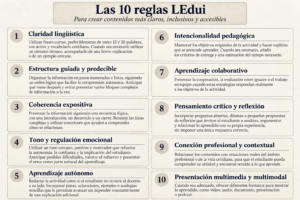
Image generated by Ángel Luis González using ChatGPT (OpenAI © 2015-2026)
The 3 principles of UDL become 10 rules:
When defining the LEdui rules, I tried to strike a balance between making their application more concrete, and ensuring that they addressed the barriers I encountered every day in my classroom.
Predictability, anticipation and reducing information overload responded to needs I saw particularly among my students with autism. Prioritising information and adjusting task length helped address some of the difficulties experienced by students with attention deficit disorders. Linguistic clarity, structure and coherence offered support to students with dyslexia and other specific learning difficulties. And simplifying language, providing examples, anticipating difficulties and considering tone connected with increasingly common needs around managing emotions and frustration.
In a way, setting boundaries made our relationship work better. UDL hadn’t changed, but I now had a concrete guide for bringing it into the classroom. We had moved beyond the initial infatuation and into a relationship that was beginning to truly work.
Measuring success in silence
Then came the moment to put it to the test. After spending so long searching for that bridge between the principles of UDL and concrete classroom decisions, I finally had my ten rules. After everything that had led me to this point, applying LEdui turned out to be straightforward. All I needed to do was provide an AI tool with the material I wanted to adapt and the ten rules, and ask it to apply them:
I’m attaching a set of activity instructions together with the ten LEdui rules. Analyse the instructions and generate a new version that applies all ten rules.
From there, AI helps us transform material we already have into a clearer, better-structured and more accessible version. There’s no need to start from scratch or become an expert in inclusion. We have the rules, we have the material and we have technology that can help us bring the two together.
And the results in the classroom came quietly: fewer students getting stuck. Fewer hands going up. And, above all, fewer instances of that familiar question: ‘Sir, where do I start?’
My students were reading, understanding and getting to work. Silence stopped being an absence of questions and instead became a sign of learning. The activity instructions were no longer an obstacle; they had become a way in.
But perhaps the most important part of all this wasn’t LEdui or artificial intelligence. It was something much more human: that moment when we stop asking why a student can’t do something and start focusing on what we can do to help them.
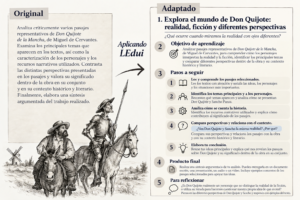
Image generated by Ángel Luis González using ChatGPT (OpenAI © 2015-2026)
I know you can do it. Let’s find a way
In the world education, our commitment as teachers will always be the best material we have for building bridges. Like Indiana Jones at the end of The Last Crusade, if we believe in it, the bridge will magically appear beneath our feet. We simply have to believe it is there, stand at the edge of the abyss and take that first step.
And perhaps that is what teaching is all about: not always knowing exactly how we’ll get there, but refusing to accept that there is no way forward.
Latest related articles

¿Puede la IA salvar al DUA?
Lo admito, me enamoré del DUA desde la primera vez que me hablaron de él. Llevo más de una década conociéndolo, formándome...
Read article
Pódcast Horizontes educativos: dislexia y educación en el aula
¿Sabes qué es la dislexia y cómo puede afectar a la lectura y la escritura? La cuarta temporada de Horizontes Educativos comienza...
Read article What are we learning today?